
Hey I released my book about the birth rate!
Free to download here
https://docsend.com/view/wc528tqgeti6s6v8
By Daniel Hess
This essay is part of a series of policy essays exploring ways to raise birthrates.
Everyone is talking about housing these days. On the right and left, people recognize that young people are having hard time getting homes. Birthrates are far below replacement, and we agree that housing bears a lot of the blame.
But this isn’t the first time we’ve been in this situation. Starting in 1925, long before modern birth control and the sexual revolution, fertility fell below replacement in more than a dozen developed countries and stayed below replacement for more than 15 years. Then as now, housing was a big cause of birthrate decline.
But the 1925-1940 fertility crisis had a happy ending as birthrates would go well above replacement for a whole generation starting in the 1940s. As we will see, housing and housing policy were central to the earlier recovery and could be part of a fertility recovery again today.
The first birth dearth
The chart below is from the paper “Subreplacement Fertility in the West before the Baby Boom” by Jan Van Bevel. It uses Net Reproduction Rate (NRR) which is the number of surviving daughters born per woman, so a figure less than 1 is below replacement.
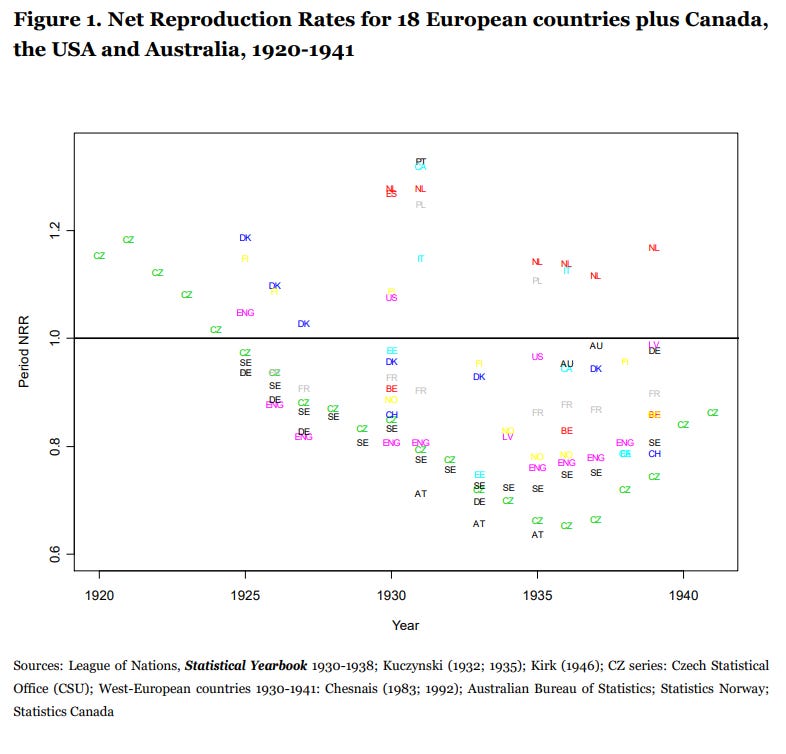
Fertility in the 1930s was below replacement across virtually the whole of Europe. In fact, in Austria, fertility went down to just 65% of replacement. The United States went below replacement in 1935.
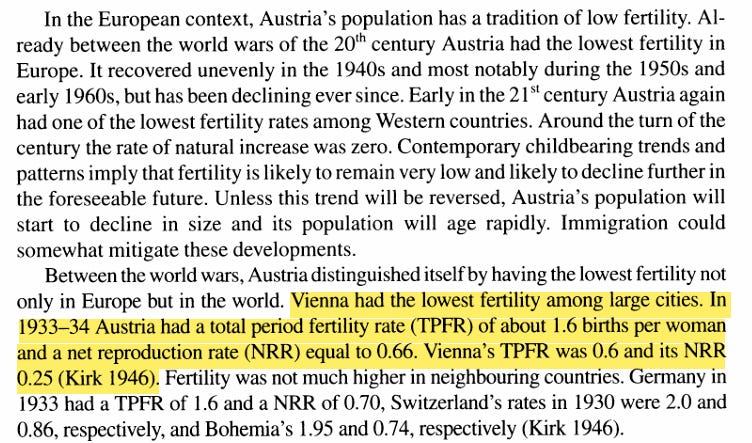
Then, as now, the low birthrate crisis was most acute in cities, which were seen as inhospitable to children. In fact, in the crowded European capital of Vienna, fertility fell to one quarter of replacement, even lower than in Seoul in 2025!
But a turnaround was coming.
The most successful pronatal program in history
Economists Lisa Dettling and Melissa Kearney published a wonderful paper in in February 2025: “Did the Modern Mortgage Set the Stage for the U.S. Baby Boom?”
In it they present a series of extraordinary charts. In the first, they show how the Baby Boom’s start lines up perfectly with new programs that helped young people borrow more to buy houses.
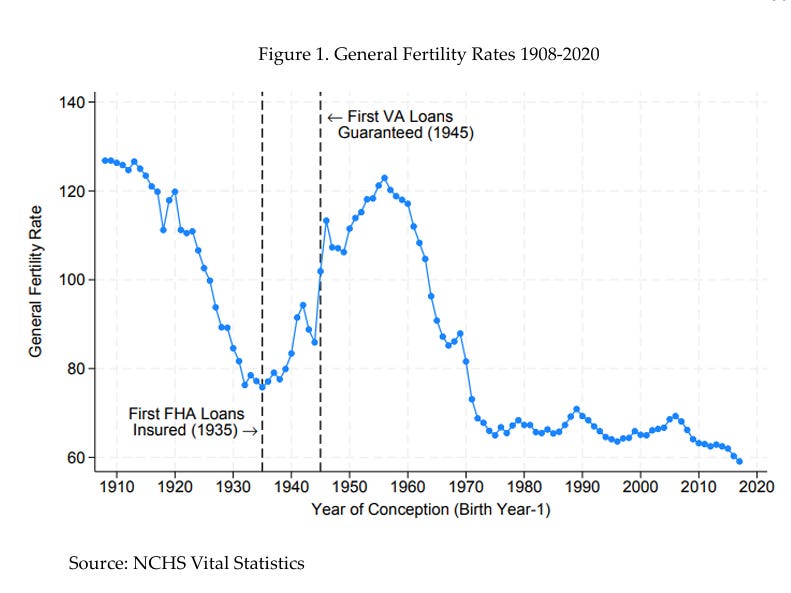
Contrary to what most people think, the Baby Boom did not begin when soldiers came back from the war but started a decade earlier with the introduction of the FHA loan program. Then when the WWII vets returned and were able to use VA loans to buy homes, the Baby Boom kicked into high gear. The first great fertility crisis was over, for at least a generation.
We can see the massive change in homeownership by age. Before the modern mortgage, most people in their childbearing years were not homeowners. Just 20% of 30-year-olds owned a home. After the modern mortgage, 55% of 30-year-olds were homeowners. Marriage and childbearing soared.
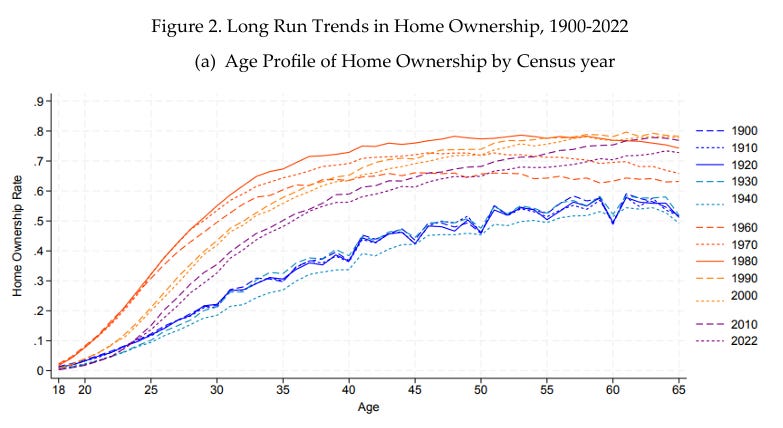
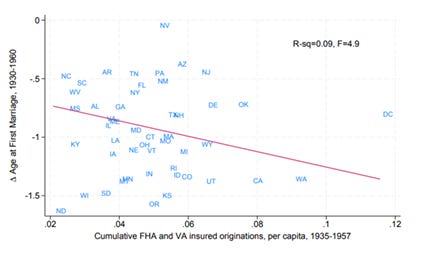
This makes perfect sense. When people were able to get a home sooner, they could marry sooner, boosting fertility. And the paper presents evidence that more FHA and VA mortgage originations per capita were associated with earlier marriages.
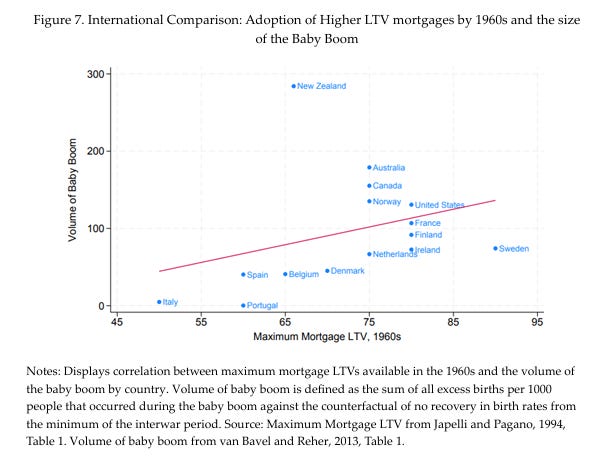
Dettling and Kearney’s paper also looks internationally and finds that other countries which adopted similar mortgage programs saw fertility soar as well.
But that isn’t the whole story of housing and the Baby Boom. What was being built and what were people buying?
The Suburbs and the Invention of Family Friendly Housing
In 1946, an entrepreneur named William J. Levitt and his company Levitt & Sons created a whole town from scratch and revolutionized housing forever. The first Levittown, created as a suburb of New York, followed a new template. Levitt purchased a 7-square-mile tract of potato and onion farms near the city and subdivided it into modest parcels. Houses were mass produced, each with its own yard and the basic amenities a family would need.
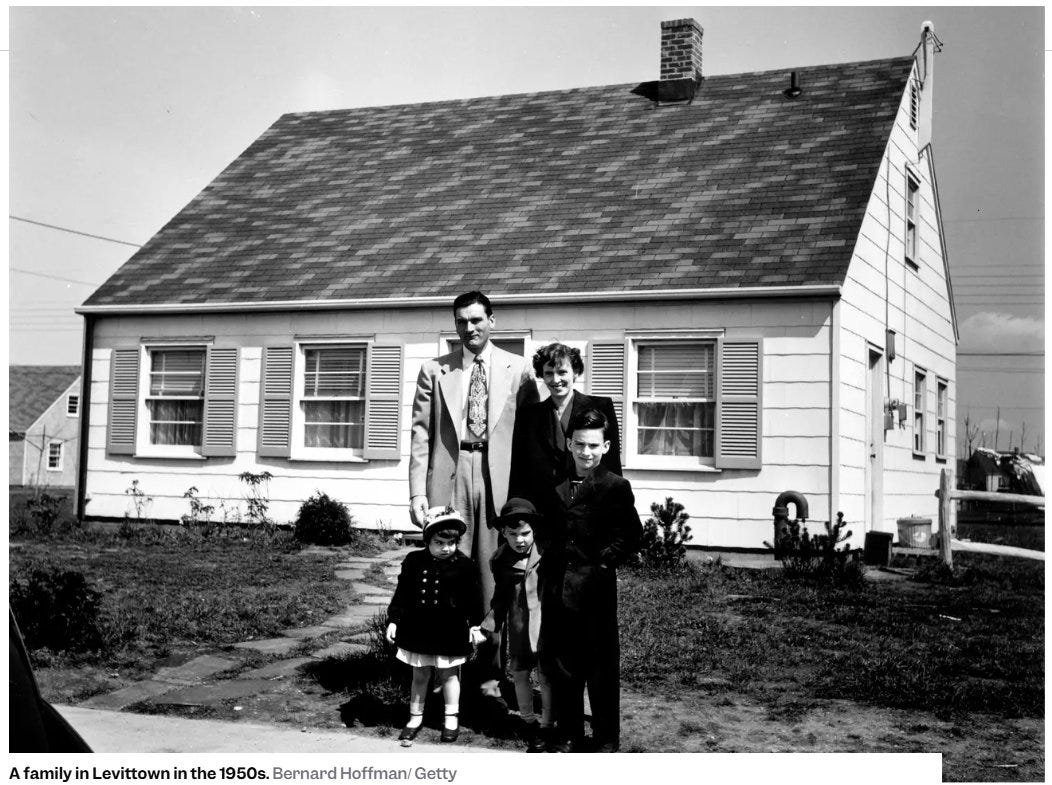
This kicked off the greatest housing revolution in history, hitting the United States from coast to coast, Canada, Australia and a number of other countries. For the first time, ordinary people could at once be part of an urban economy and have also have a house well-suited for a family.
Until the invention of the suburb, most people had an unappealing set of choices. Either be isolated on a farm or in a small town, with plenty of room to raise a family but little economic opportunity, or else move to the city, where economic opportunity was high, but you would be stuck in a crowded building that was bad for raising kids.
This had been the story of humanity since time immemorial. Cities were “fertility shredders” -- bastions of opportunity but wreakers of birthrates. Although cities were economic engines, they were not self-sustaining. They had to continually draw new people from the countryside, where birthrates were higher.
Suddenly with Levitt’s great innovation, plus the automobile, everything changed. Regular people could both be integrated into the productive urban economy and have a house that was suitable for raising children, with a yard to play in and a little air gap so the noise wouldn’t upset the neighbors. And with those new mortgage programs, people could buy that house early in life, while they were still young enough to have children.
Levitt’s houses, modest though they were by today’s standards, were hugely popular. Built in assembly-line fashion, they were completed at a rate of one every 16 minutes, and 1400 houses were sold in the first three hours. By the time the first Levittown was finished in 1951, 17,500 houses had been built, accommodating nearly 100,000 people.

All across America, thousands of suburbs were built with variations on the Levittown model. As Green and Wachter wrote in 2005: “With the strong expansion of the U.S. economy in the post–World War II period driving up incomes, together with the new institution of the long-term (and therefore affordable), fixed-rate, self-amortizing mortgage, homeownership expanded rapidly. America was transformed from a nation of urban renters to suburban homeowners.”
The Baby Boom was Greatest in Countries Where Suburbs Exploded
How crucial were the suburbs in driving the Baby Boom? Consider:
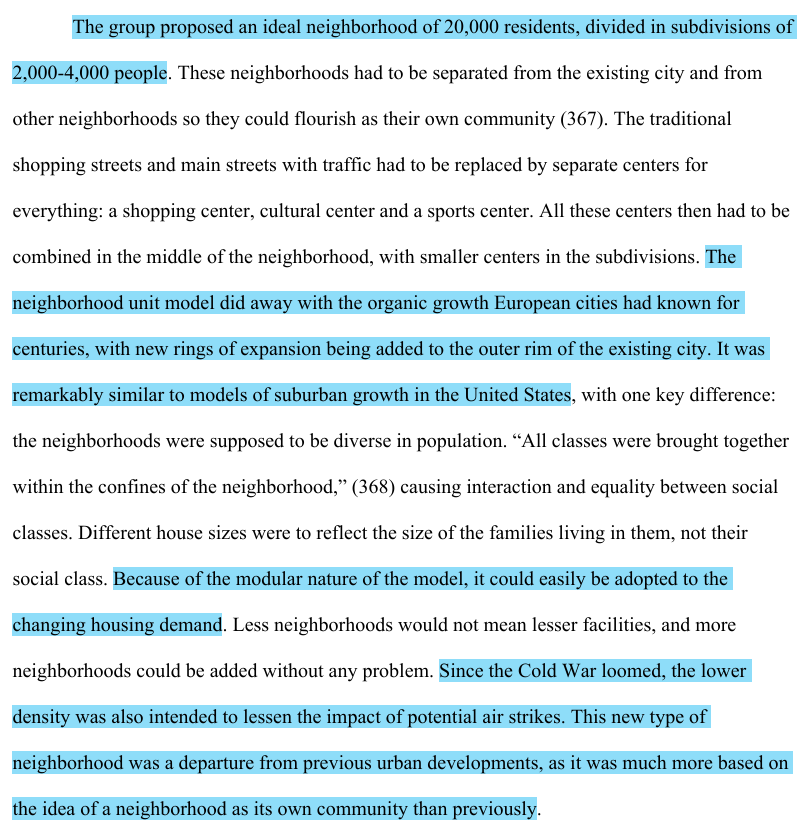
When we look at countries that the most powerful baby booms, the top five winners were the United States, Canada, Australia and New Zealand along with the Netherlands.
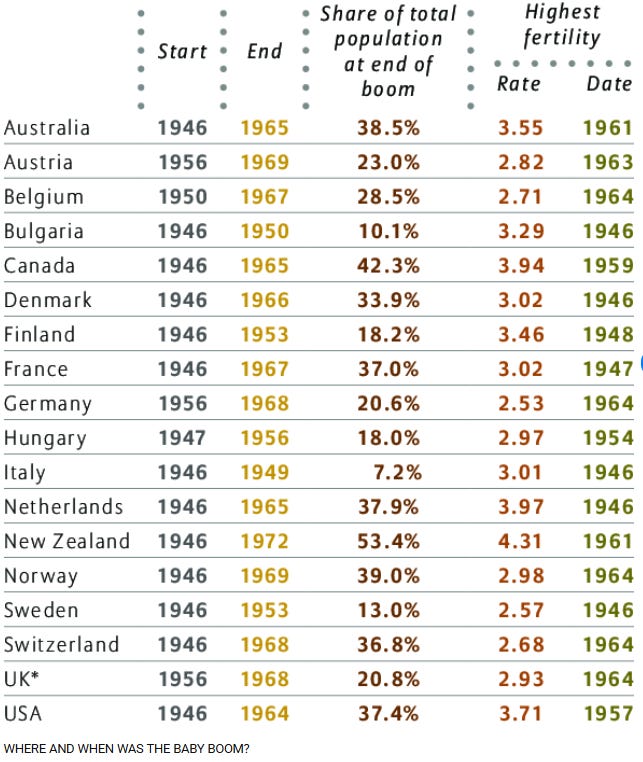
What do the United States, Canada, Australia, New Zealand and the Netherlands have in common? All five embraced the new decentralized suburban model with gusto.
It is pretty well-known that Canada, Australia and New Zealand followed America in the great suburban explosion, being culturally similar to the United States. But the Netherlands? It turns out that the Netherlands too embraced US-style suburban building after the war as a 2016 paper explains.
For Fertility, Follow Data, Not Fashion
Suburbs aren’t fashionable. Instead, the building ideal among fashionable thinkers and pundits looks like this:

The cover of Ezra Klein and Derek Thompson’s new bestseller Abundance shows the modern vision of what development should be. Urban sprawl is nowhere to be seen, as we transition seamlessly from beautiful futuristic urban towers to farmland and pristine nature.
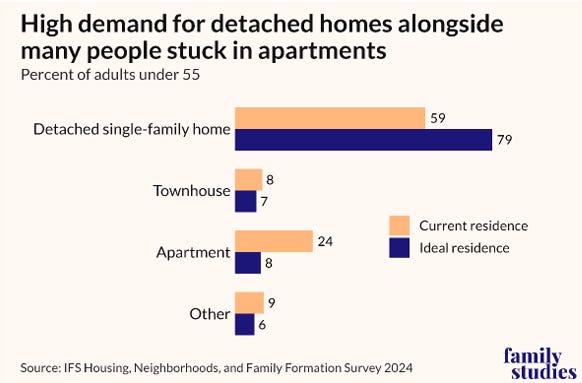
There are some problems with this ideal. First of all, it’s not what people want. The Institute for Family Studies surveyed almost 9000 Americans to find out what sort of housing Americans prefer. Some 79 percent said that their ideal residence is a single-family home while just 8 percent said they prefer an apartment.
But second problem is even more acute.
Within greater London, the central district known as the City of London comes the closest to those gleaming glass towers of Klein and Thompson’s cover. If you are a certain kind of urbanist, this looks glorious and your heart soars.

Do you wonder what the TFR in the picturesque cityscape?
There are a few places where it is possible to get fertility data on a very granular level. London is one such place. Here is the fertility rate of London, neighborhood by neighborhood.
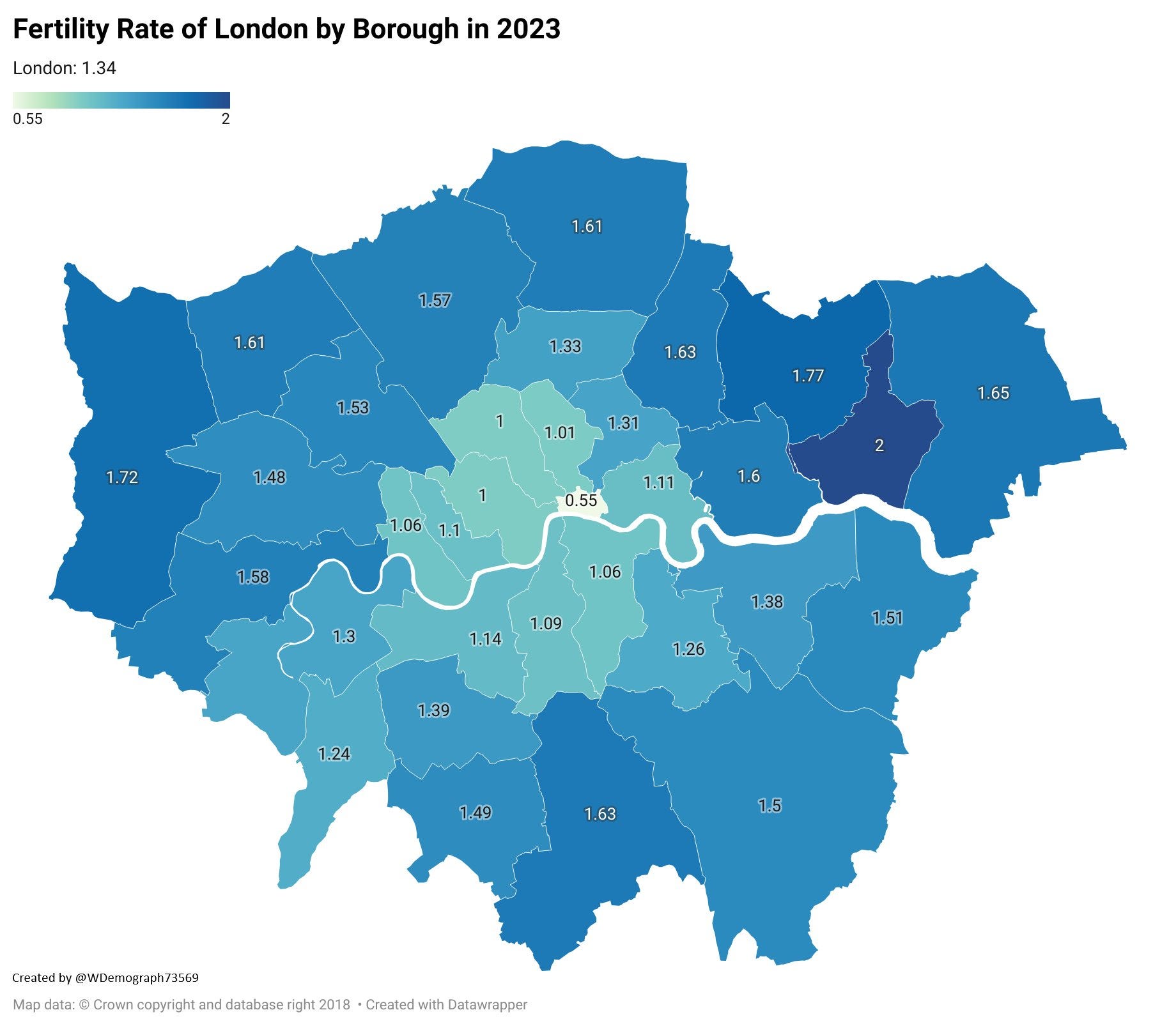
Do you see that area in white at the top of the bend in the Thames? That is the area of those towers pictured above, and its fertility is just 0.55 births per woman. If you are a pronatalist like me, you may get heartburn.
To be fair, only around 10,000 people actually live in the City of London; most only work there. But what about the neighborhoods of smaller apartment towers all around the downtown? Those are all residential and they have a fertility of only around 1.0 to 1.1. Keep in mind that many of those are heavily immigrant neighborhoods, where one expects fertility to be higher.
But then you get out to the leafy neighborhoods of houses with gardens and fertility is 1.6 to 2.0, nearly at replacement. What a difference!

(Some argue there is selection bias in fertility maps like this. Maybe people who want kids ‘select out’ of inner London. But if that’s true, it supports the thesis that certain housing types are better for families!)
But don’t we need those apartment towers to bring people closer together for greater economic cooperation? Don’t we need more density to have progress? Hardly!
Consider: At the density of the London suburbs, England alone, not counting Scotland or Wales, could still house 500 million people! Not only is extreme crowding bad for fertility. It is also completely unnecessary!
It’s rare to have such granular fertility data that we can look neighborhood by neighborhood across a city, and we don’t have that level of detail for the US. But like the UK, Australia has that data. And the fertility divide by housing type is stunning.
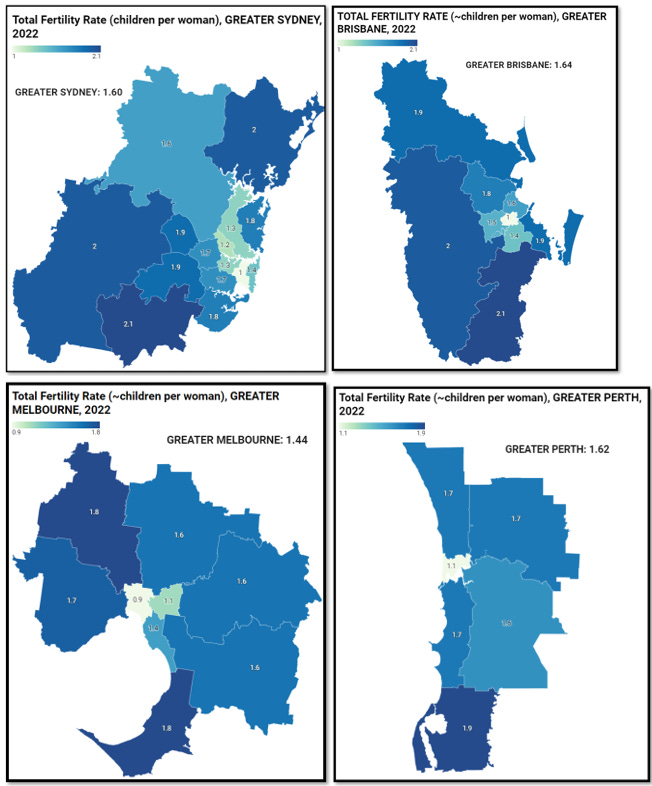
In Sydney, Brisbane, Melbourne and Perth, the fertility rate ranges from 1.6 to 2.1 in the suburbs of single-family homes and just 0.9 to 1.1 in the apartment block-based urban core. That is up to a 100% fertility difference based on housing type and neighborhood alone. In demography, that is an absolutely enormous effect. If some pronatal policy increased TFR by just 0.1, many would consider it a win.
What Pronatal Housing Policy Would Look Like Today
If we want to “fix housing” in a way that supports long term thriving, we can’t simply follow fashion. The fashion these days is to upzone cities, get rid of single-family zoning, and build upward. But that has been tried, in Minneapolis, Auckland and Chicago. And in all of these cases, birthrates went down compared to nearby cities, because the type of housing being built wasn’t friendly for families.
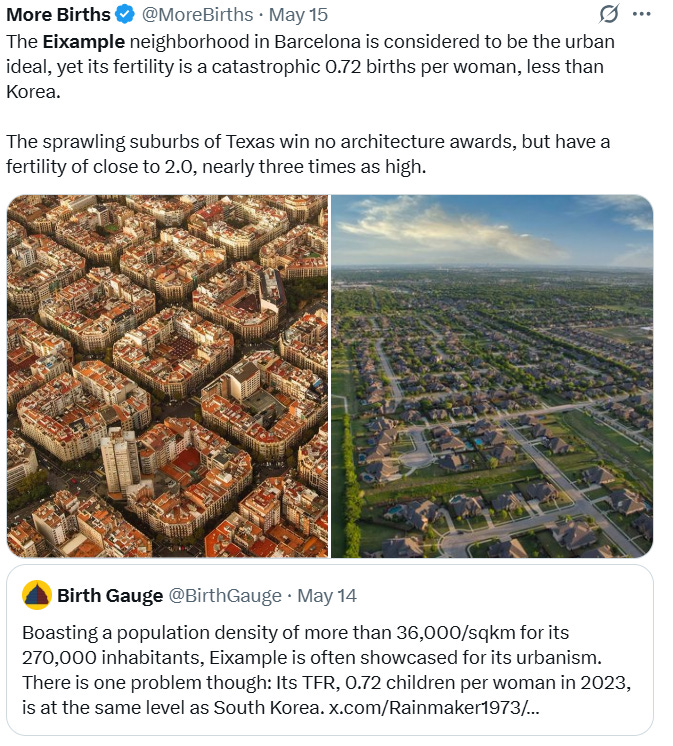
To solve the fertility crisis, we should repeat the formula that gave us the Baby Boom: get family-friendly houses into the hands of young people early, while the fertility window is open.
Here are some ways to do that:
Get rid of urban growth boundaries and build more suburbs. The housing crisis is really about a lack of the kinds of homes that are suitable for families.
Give preference to young people in mortgage programs. The social value of mortgages lies in helping the young buy houses years earlier than they otherwise would.
Open government land to build houses. Somehow Federal land is seen as sacred and untouchable. But consider the case of Canada. Some 89% of Canada is government-controlled “crown land”, off-limits to building. Amid this artificial land shortage, Canada has been building large blocks of small apartments and fertility has fallen to just 1.25 births per woman. That is not a model to follow.
Don’t exempt people from property taxes.
This article hits the nail precisely on the head. If you want families, let them have a nest.
But adding more suburbs on the outer margin of existing urban areas is a recipe for congestion, addiction to automobiles, time wasted in getting from place to place, accidental injury and death, speeding fines, falling asleep at the wheel, speed limits, massive freeways, air pollution, loneliness, children unable to find others to play with, addiction to smartphones and poor school performance. Rarely will people know the name of their nearest neighbour. These are not communities. If you want a community plan for a village where kids can walk to school and parents to work. The village needs to be surrounded by green space. You will never see skyscrapers surrounded by green space, but a village, yes.
Hi, and thanks for this great series of articles. Do you see evidence that fertility responds differently to access to homeownership versus access to affordable rental housing? If so, what mechanism explains this gap?