
By Daniel Hess
This essay is part of a series of policy essays exploring ways to raise birthrates.
Perhaps the most alarming aspect of the global birthrate crisis is how it seems to be happening almost everywhere. Low fertility is acutely afflicting every part of Europe, East Asia and almost all of North and South America. Over and over, we hear that “nobody knows” how to reverse falling birthrates.
But that isn’t really true. Right in our midst are groups that are forging a path, trying and succeeding at creating subcultures that manage to have healthy birthrates within modern societies.
Why does the United States, the richest big country in the world, have higher fertility than France, Sweden, Hungary, Japan? All of those countries have a big basket of pronatal policies while the US has hardly any.
A big part of the answer is that America has a lot of high fertility subgroups within it. The groups with higher birthrates include of course well-known groups like the Amish and Orthodox Jews but also traditionalist Catholics, and numerous protestant denominations and other religious groups. That is only possible because of America’s deep tolerance of different beliefs.
On the flip side, why do East Asian countries like China, Japan and Korea have among the lowest birthrates in the world? One reason is that there aren’t any high-fertility subcultures left to show the way. And to an extent that is a self-imposed problem. East Asian countries value conformity and have a hard time tolerating big cultural differences.
How Freedom of Belief Drove the Greatest Population Growth in History
What country achieved the fastest sustained population growth in world history? That title surely belongs to the United States in its first centuries. The American colonies grew from just 2000 people in 1620 to 250,000 in 1700, 2.5 million at the time of Independence in 1776 and 76 million by 1900. That means America grew by 38 thousand times in just 280 years.
While immigration contributed to this growth, the vast majority of it was because of very high birthrates, above 7 births per woman until 1800 and dropping gradually to 3.5 births per woman by 1900.
No other country in history has seen growth like this:


How did America achieve such robust fertility, generation after generation? Europe by contrast had much lower fertility and grew from 78 million to 400 million in that 280-year span, a gain of just fivefold.
Much of the answer lay in America’s religiosity. Founded partly as a refuge from religious persecution, the colonies were intensely religious and very fertile.
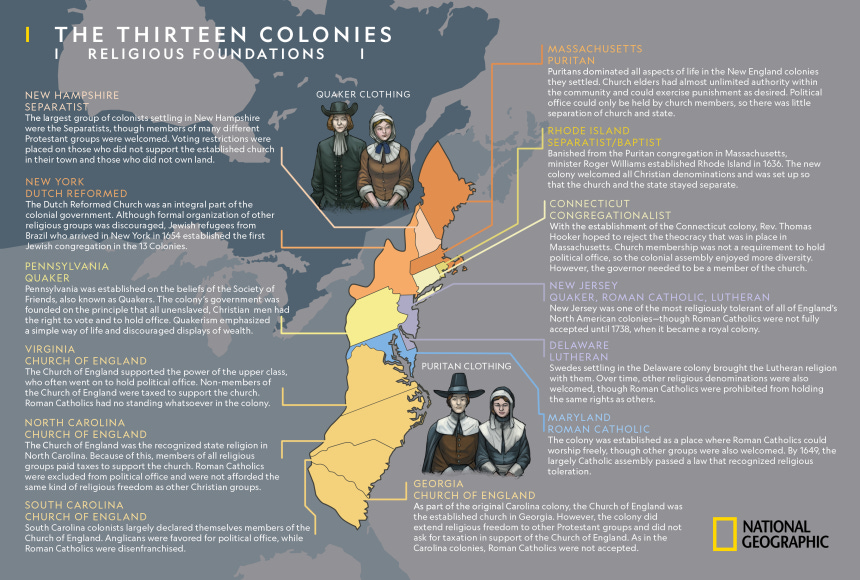
Most of America’s founding denominations have faded. The Puritan, Dutch Reformed, Congregationalist and Anglican churches are now each less than 1% of the population. Less than one in a thousand Americans is a Quaker today.
But other faith groups grew as the original ones waned. No less than three Great Awakenings kept America in a state of revival and helped keep the young nation growing.

As old denominations lost their luster, new ones rose up in their place. And it was religious freedom that made this possible.
The US Bill of Rights starts with religious freedom before any others: “Congress shall make no law respecting an establishment of religion, or prohibiting the free exercise thereof...”
Not only did America’s founders view faith as a good thing; they barred the government from being able to intervene in people’s choices about it.
Amid a backdrop of strong freedom of belief, this process of decline and renewal is still happening today. Mainline protestant churches (the large denominations that dominated 20th century America) are losing membership. Catholic churches, which surged in the 20th century, have also seen waning attendance. But something new is picking up, nondenominational churches.
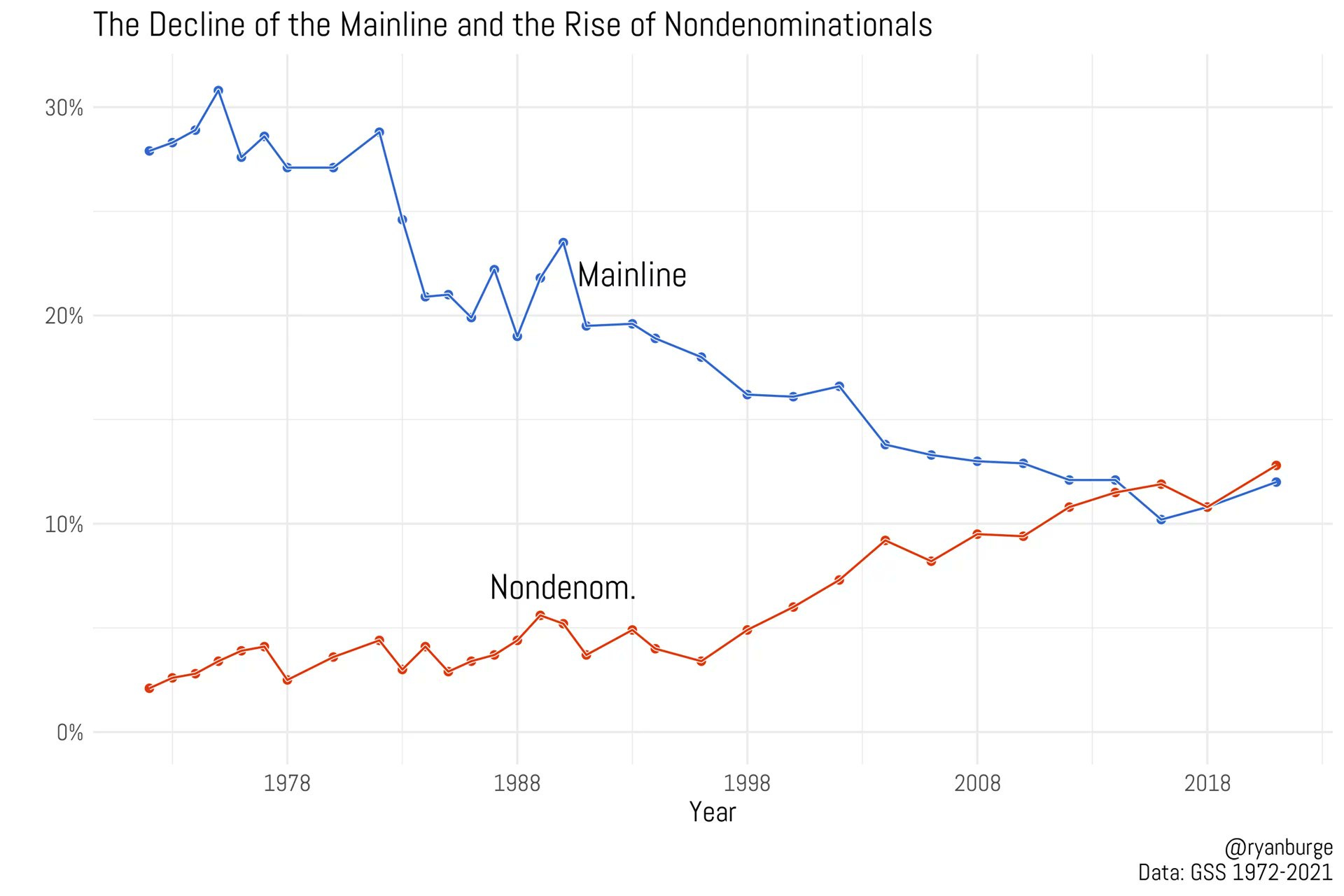
What are these nondenominational churches? A lot of them are startups. They are entrepreneurial and independent and sometimes with a charismatic leader they can be hugely successful.

Most developed countries do not allow this level of religious and cultural experimentation and so they stagnate.
But religious freedom isn’t just for new faiths, and it isn’t just for Christians. In a letter to the Touro Synagogue in 1790, new president George Washington wrote that the government “gives to bigotry no sanction” and “to persecution no assistance.” Touro was based in the colony of Rhode Island, which was the first government in the world to guarantee religious freedom in its founding document in 1636.
When you look at fertility by language spoken at home in America, the two languages that top the list are Yiddish and Pennsylvania German, representing Haredi Jews and the Amish respectively. Both of these groups fled persecution in Europe to thrive in America.

The case of Yiddish speakers is especially poignant. Some 85% of those who perished in the Holocaust were Yiddish speakers, and now with the American guarantee of freedom of conscience, they are growing again.
Are Fertile Subcultures the Answer?
What explains the near-universal nature of fertility decline? Some of the most astute thinkers on the topic have explained that there is a global convergence of cultures today as the same norms (such as long educations, delayed marriage, and widespread Internet and social media) spread worldwide. The renowned futurist Robin Hanson (here is one of my conversations with him) talks of “modernity’s monoculture mistake.”
His essay Beware Cultural Drift explains it best.
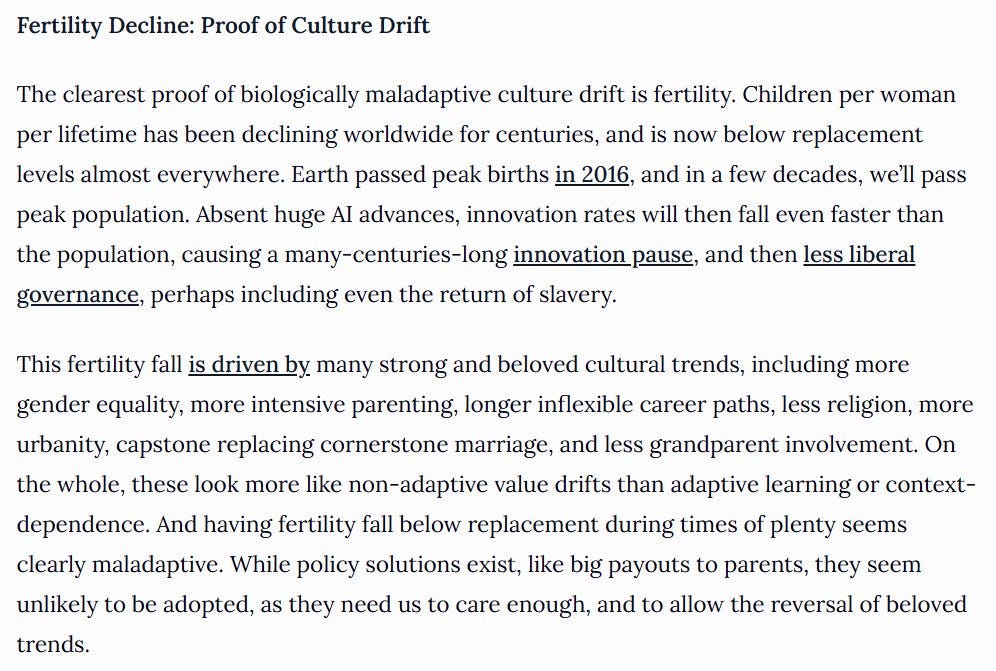
When there were many small subcultures in the world, there was competition and selection. Subcultures had to maintain healthy fertility, or they would disappear and be replaced. But now a global monoculture is taking root, and this process of cultural evolution isn’t working anymore. We are adrift.
How can we answer this? Hanson notes that we can attempt to force cultural change from above which is difficult and lacks a consensus. Or we can allow deep multiculturalism.

I would argue that what Hanson calls deep multiculturalism, a tolerance for fundamentally different beliefs, is at the very core of American tradition and has been central to America’s cultural evolution and demographic success over the centuries.
Israel, the only advanced country that avoids fertility collapse
There is only one developed country in 2025 that combines modern life (urbanization, high education and high technology) with high fertility and that is Israel.
Among Jews in Israel, fertility has remained remarkably stable over the last 40 years, an incredible accomplishment in a world that has faced steep fertility collapse in that span.
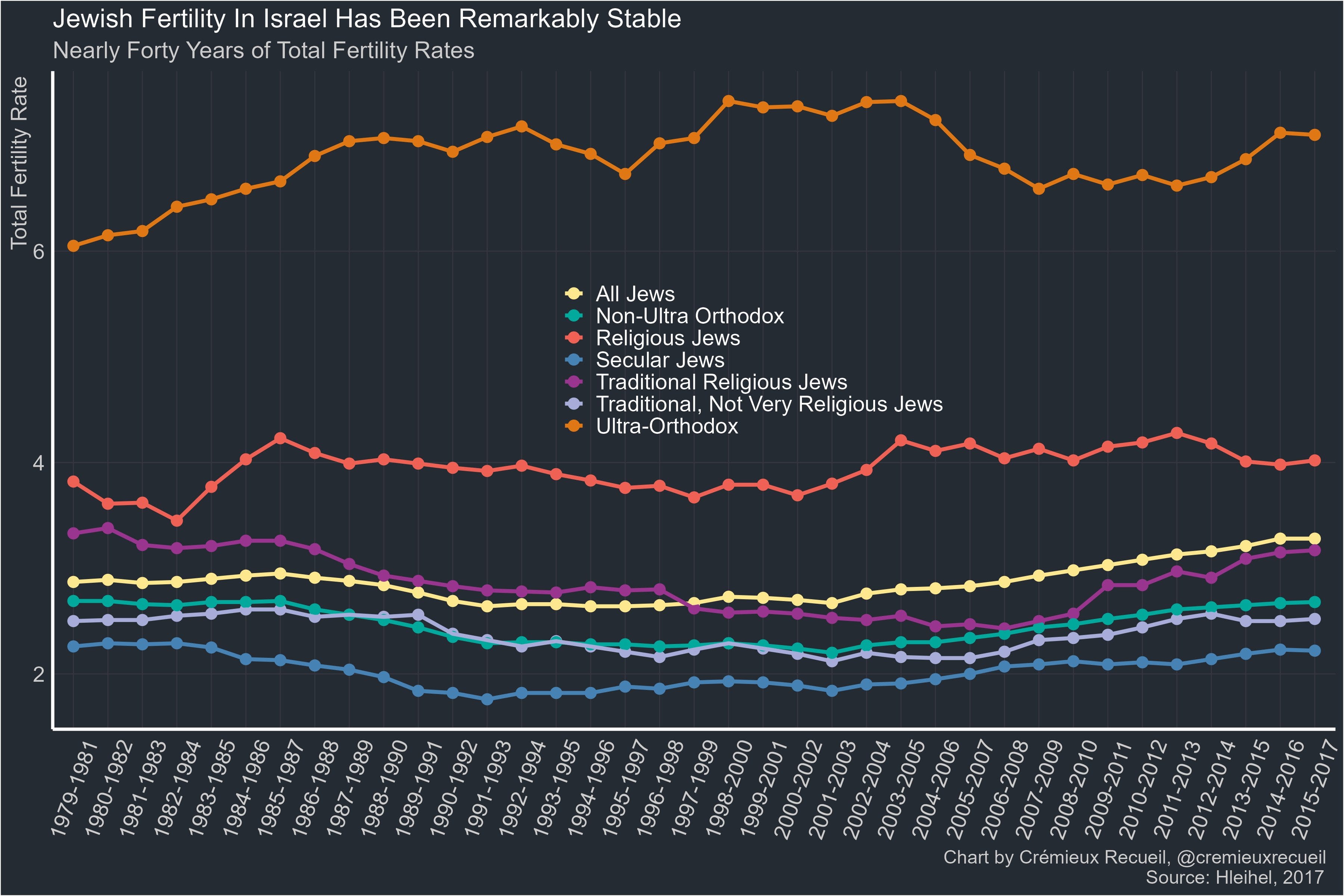
But within this group there is enormous diversity of belief, and this produces vastly different fertility rates. The ultra-orthodox, who are about 13% of the population, lead the way with nearly 7 births per woman. For them having children is seen as a mission from God. Secular Jews, who are 50% of the population, pull up the rear with 2 births per woman.
That two births per woman among secular Jews may not seem so important, but actually it is a very big deal. For a secular, urbanized and modern population to have two births per woman is unheard of in today’s world. Elsewhere in the world, the fertility of similar groups is only around half of that.
What is going on? Why is Israeli fertility so high even among non-religious groups? An Israeli pundit with the handle NonZionism explains this as trickle down natalism.
He writes, “fertility in a post-contraceptive world is basically mimetic, which is a ponce way of saying that people decide to have x number of kids based on looking around at how many kids the people around them have, who in turn have that many because they looked around at how many kids the people around them were having. However, if fertility rates are recursive in this way, how can they change?”
He goes on to explain that the fertility norms of high fertility subgroups, such as the Haredi, are spreading out across the rest of society. Is this plausible? I think so, especially since a large share of secular Israelis come from more religious households and learn their fertility norms there.
And this shows the value of religious pluralism for society. The family norms of natalist subcultures can bleed out into broader society and make it more pronatal. Not only that but these subcultures are a valuable population source as many of their numbers join wider society.
Finland and the Outstanding Laestadians
Finland, in spite of pronatal benefits that are among the world’s most generous, had a fertility of just 1.25 in 2024, the lowest ever recorded. It is cases like Finland that lead people to throw up their arms and declare the fertility crisis to be hopeless.
And yet even in Finland, there is a subculture that defies the trend. Larsmo is a town of 5,700 people on the west coast of Finland that is notable for its high share of Laestadian Lutherans.

While fertility has collapsed across Finland in the last eighty years it has remained high in Larsmo and other Laestadian towns.
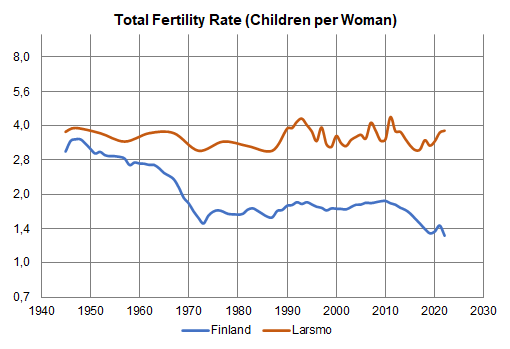
Many high fertility groups are isolated from broader society. Not the Laestadians.
The Baby Belt of the Netherlands
The Netherlands is mostly a secular country and has a fertility rate of just 1.43 births per woman, far below replacement. But there is a “Dutch Bible Belt” with a higher percentage of conservative Protestants. We can see it in the data because the Calvinist SGP party gets a significant share of the vote in these places.
Lo and behold, these municipalities have fertility that is consistently at replacement of around 2.0, far above the Dutch average.

East Asia and the Problem of Conformity
The lowest fertility region in the world is East Asia. Fertility will be just 0.81 in Korea, 1.13 in Japan and 1.02 in China in 2025. One of the first things a demographer notices about East Asia is that there aren’t really many higher fertility subgroups to move norms higher.
In China, weekly church attendance is just 1%. Japanese church attendance is even lower. This is no accident. Neither country has a tradition of religious or cultural freedom. The CCP’s attitude toward faith groups is well-known, but few know the lengths that Japan went to, to eradicate Christianity when it began to take root.
If the only groups that can manage bring about healthy birthrates in the modern world are religious, then East Asia has a big problem.
South Korea had been doing better in that regard. Not lately. In 2025, with the ascendance the left-wing President Lee Jae Myung, a series of church raids has thrown the country into political turmoil and called into question its commitment to religious liberty. The leader of the Unification Church, known for its mass weddings (something you would think Korea could use a lot more of right now), has been jailed as have been several other faith leaders in what is widely viewed as a politically motivated crackdown on political opposition.
In terms of religious tolerance, another question arises. What to do about faith groups that are intolerant of others? Perhaps the Religious Settlement of Elizabethan England offers a clue. More tolerance was granted to groups that showed greater tolerance themselves. Rough as it was, the settlement held.
Can there be healthy birthrates without faith?
If you’re like me, you’d love to see some non-religious groups manage to achieve high birthrates too. But so far there don’t seem to be any.
That means countries struggling with low birthrates would do well to adopt strong religious freedom and give fertile subcultures room to thrive. America is a pretty good model.
Religion is hateful lies. They already have all the stupid rights and freedoms they could want, they especially like to use these rights to oppress anyone who won't follow their ignorant, idiotic book! Religious freedom yet people are leaving, gee I wonder why!