
This essay is part of a series of policy essays exploring ways to raise birthrates.
With birthrates having fallen to incredibly low levels in country after country, many pundits have declared that “nobody knows why fertility is falling” and “nothing can be done” to turn around the declines.
This grim perspective is understandable. If you’ve seen a global fertility map and really gotten what it means, it is the stuff of nightmares.
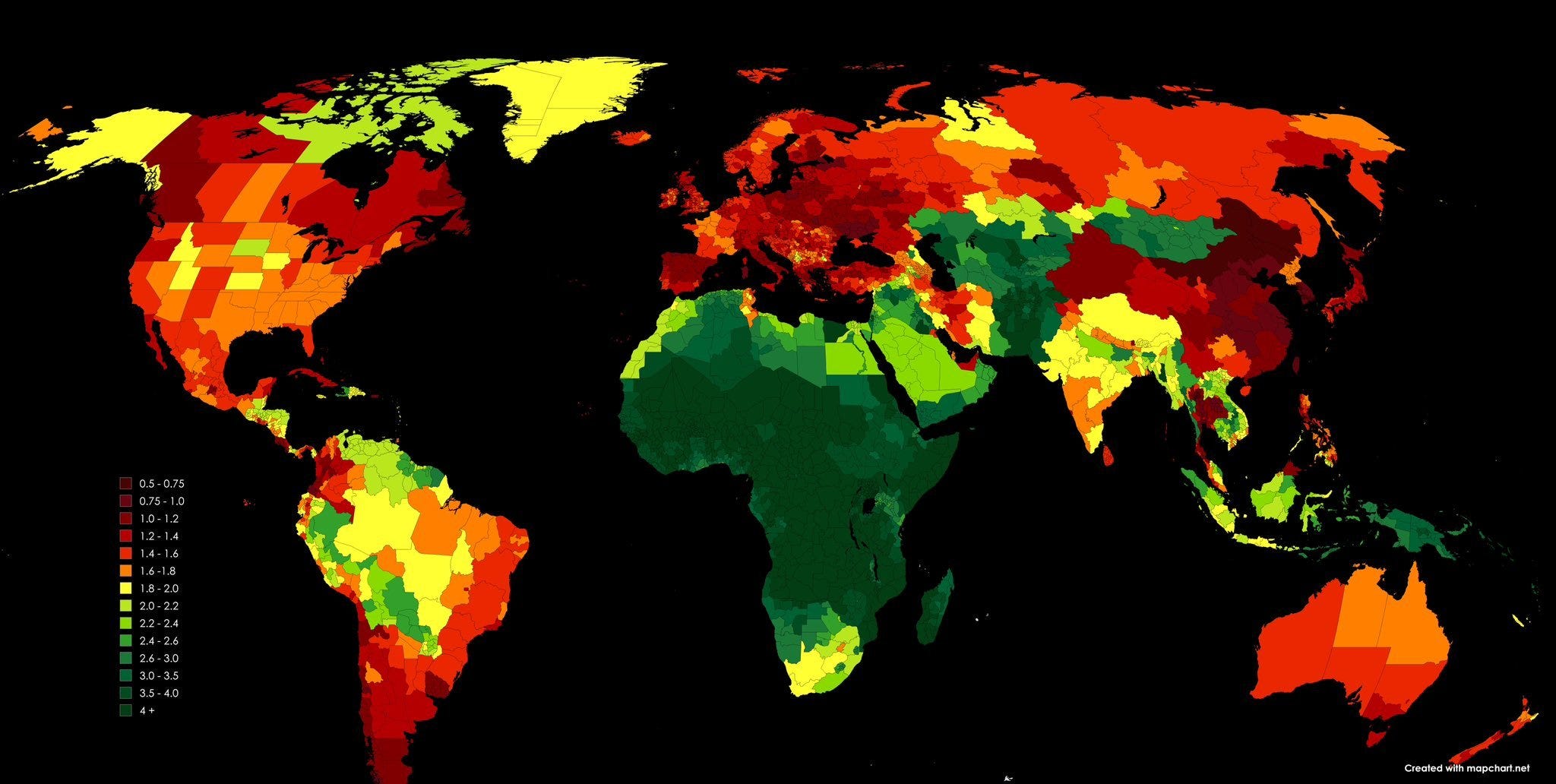
Lots of countries face catastrophic decline, the global economy will be devastated, and brilliant futurists like Robin Hanson believe that innovation will grind to a halt, because the groups with the lowest fertility are the ones with the most innovation.
Given the magnitude of the birthrate crisis, it seems like everyone should be focused on this, with the greatest minds working to solve it. But outside of @ElonMusk and a few oddball pronatalists, most people are tuned out.
Fundamentally, hearts and minds haven’t been won over yet.
Survey after Survey Shows People Put Low Priority on Having Children
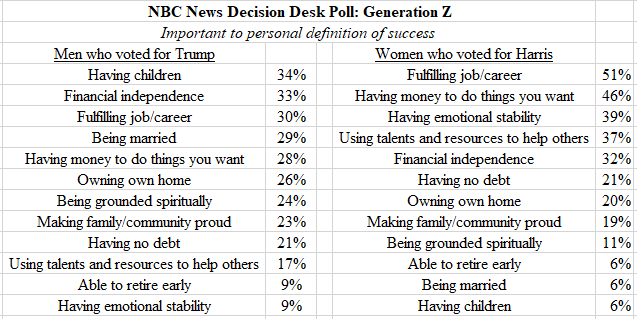
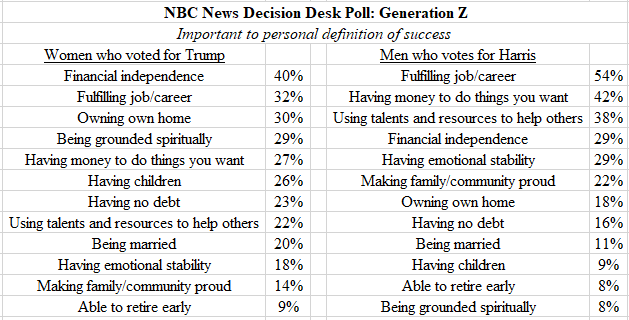
A shock poll just went viral showing how little having children matters for most peoples’ idea of ‘success.’ Conservative women ranked “having children” sixth in importance behind such things as homeownership, having a fulling job and “having money to do things you want.” For liberal women, “having children” ranked dead last in a long list of priorities.
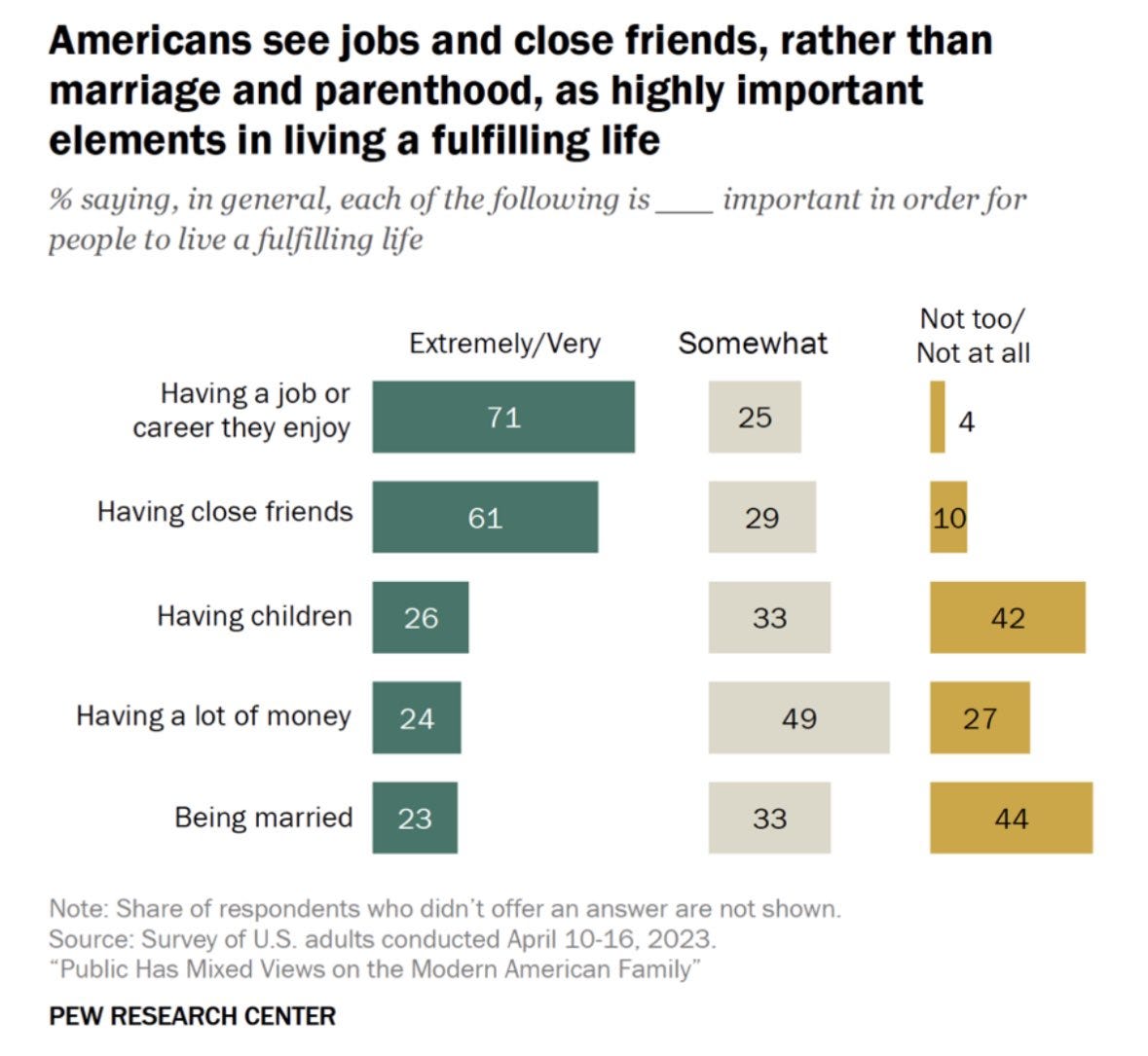
But this wasn’t the first time such sentiments were expressed. In fact, they mirror the results of a 2023 Pew Research Center poll that found that 71% ranked having an enjoyable job or career as very important for a fulfilling life compared to just 26% who ranked having children as very important. The same poll found that 42% said having children is unimportant.
If these priorities seem off, consider what parents of young adults are saying. A 2022 poll also by Pew found that 88% of parents said it is at least somewhat important that their children find a job or career they enjoy while only 20% of parents said it is at least somewhat important that their children have families of their own one day. By contrast some 46% of parents said it is unimportant if their own children have a family.
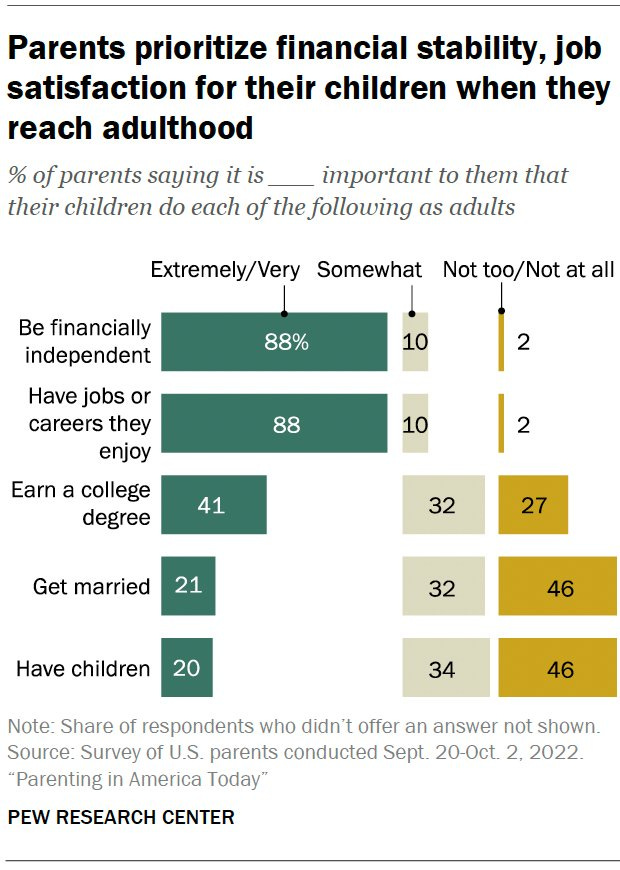
Pro-family people will have different ways of trying to explain away polls like these -- maybe the wording was biased -- a so-called push poll. These polls imply that most people just don’t put having children high on their list of goals, and that wouldn’t make sense, would it?
It hurts to admit it, but these polls are probably just what they seem. After all, we now have the lowest birthrates in history, in almost every country in the world in spite of abundant food and resources.
Reacting to yet another similar poll, Richard Hanania does not mince words:
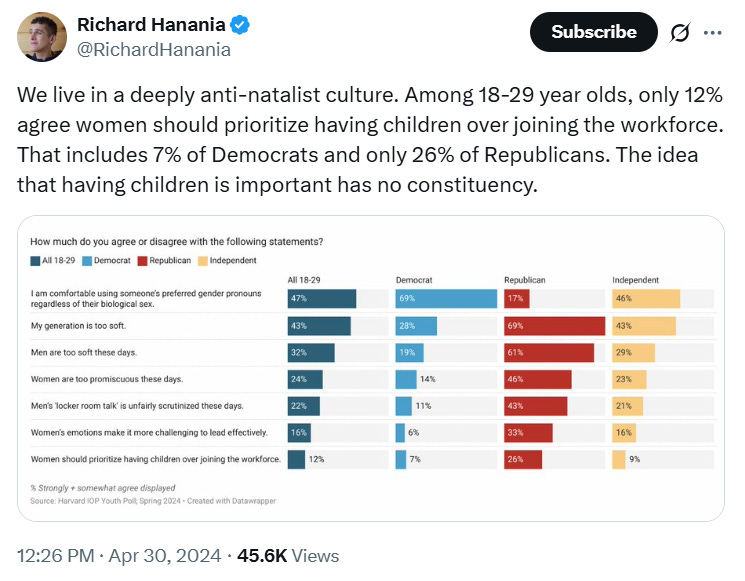
Do we have an antinatal culture? The polls seem to say that, and that is the most obvious explanation for what is happening around the world. If you are keeping track, that is four different polls by three different pollsters showing that having children just isn’t a high priority for most people compared to paid work.
Most Aren’t Even Aware that Low Birthrates Are a Problem
How can people be so unconcerned about having kids in the middle of a low birthrate crisis? The answer is simple: they don’t know it is happening.
In 2024, YouGov published a poll of 3,386 US adults that asked a simple question: “Are there too many children being born or not enough?”
Below are the results. Slightly more people thought that too many children are being born.
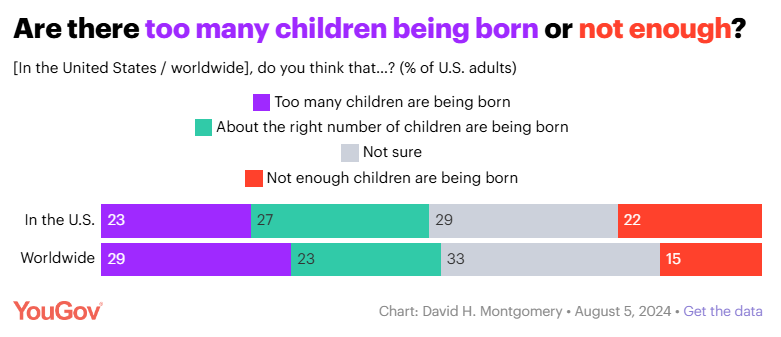
But among young people and women, the ones actually in control of childbearing choices, it wasn’t even close. By a 2 to 1 margin, women thought that too many children are being born in America. This antinatalist sentiment prevails for everyone under 44.
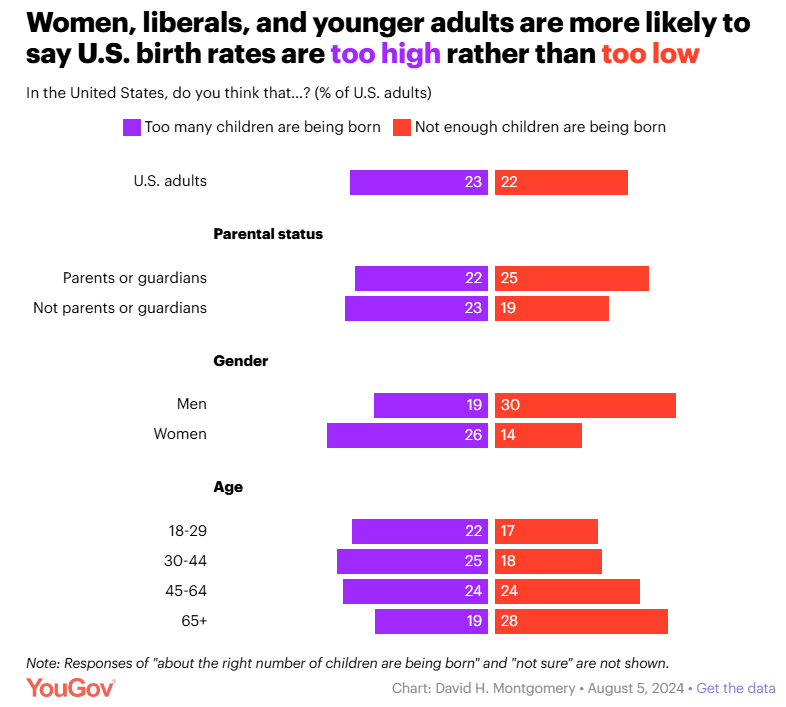
Among women under 44, the ones chiefly responsible for making fertility decisions, YouGov found that just 10% even believed that there is a problem of low birthrates in America.
Another poll, by Newsweek in 2024, asked: “Are you concerned by the falling birth rate in the United States?” People were told that birthrates were falling and still, 42% responded that they were ‘not at all concerned’ while just 16% said they were ‘very concerned.’
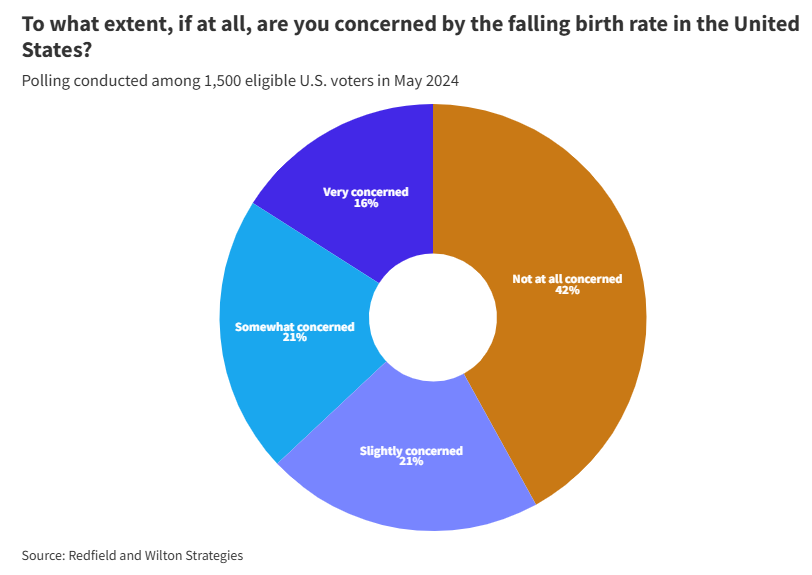
It is nearly impossible to solve a problem that you don’t even recognize.
Bad Population Forecasts
If birthrates are collapsing where is the alarm? One problem is that the ones responsible for reporting on population have missed the mark.
The agency most relied on for giving population forecasts is the Population Division of the United Nations, through its huge World Population Prospects report published every two years. Everyone from governments to media to academia uses UN projections to understand and report what will happen with population.
But the UN forecasts have been horrendous, with the actual number of births in country after country coming in far below projections.
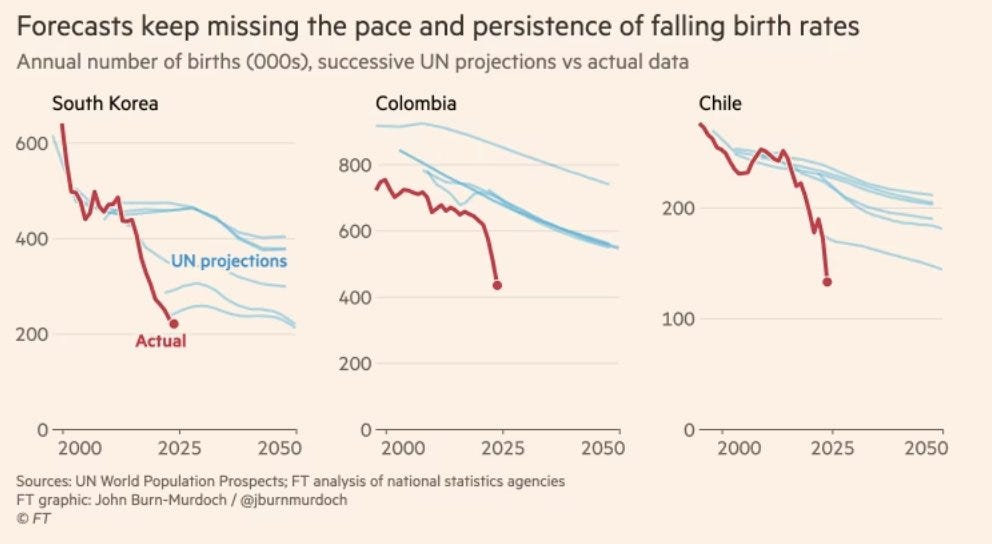
On top of this, the UN’s forecasts show fertility recovering in most countries absent any evidence. Consider what the UN’s World Population Prospects 2024 report had to say about Argentina.
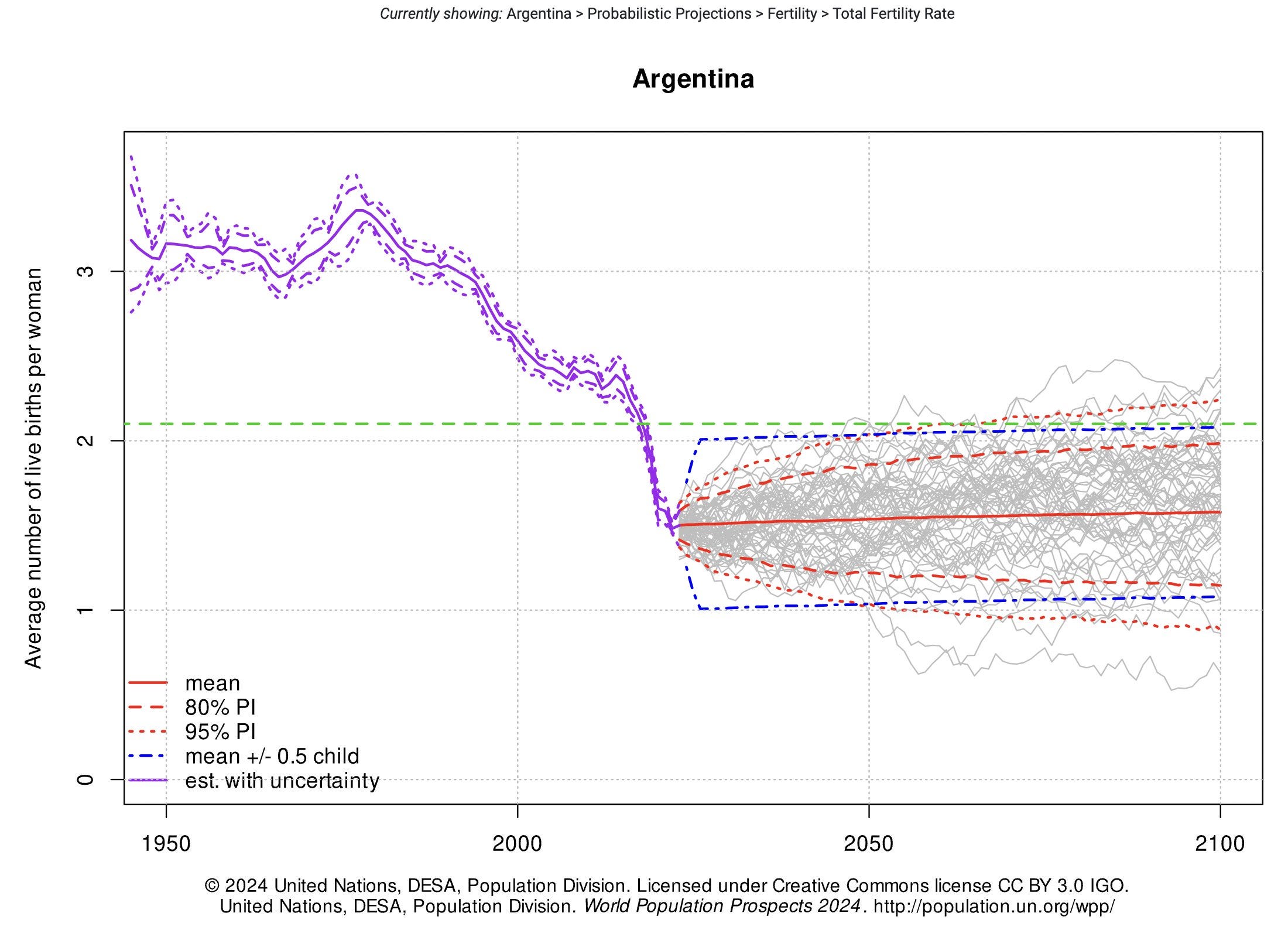
Seeing this graph, mathematician David Bessis quipped, “Please explain the physical law that makes a falling knife stop falling in mid-air.”
In this case UN data was badly off from the moment it was published. According to the UN, Argentina’s TFR was 1.5. But in reality, the TFR of Argentina was just 1.24 in 2024 and it’s just 1.14 so far in 2025. These figures are according to official statistics from the Argentine government. So it goes with country after country.
Other sources people rely on aren’t any better. If you ask Google or AI about the latest fertility for Argentina, the number you get is again 1.50, a figure that is 5 years out of date and makes the problem seem much less serious than it is.
Population control messages persist
If bad data is one reason people don’t see the birth crisis, another reason is the persistence of population control messages and groups pushing them.
Many organizations from the Population Council to the Population Institute, Population Connection, the Population Media Center, Population Matters, Negative Population Growth and more were founded years ago with the objective of getting the public to have fewer children.
Even though the facts have changed, most of these organizations are still very active spreading the gospel of population control. What comparable organizations exist to spread the word that the world needs more people?
Bismarck analysis Marko Jukic argues, “There is no such thing as a free marketplace of ideas where the best ideas win. The ideas that win are the most organized ideas, and organizing ideas is a full-time job. If nobody is paid to do it, it won’t be done.”
Can countries just ask people to have more children?
For almost 50 years since the 1970s, China pushed people to have fewer children, first through propaganda and then though the infamously brutal one-child policy. Taiwan, Japan, Korea and a bunch of other countries in East Asia had gentler population control compaigns. In every one of these countries, the programs were devastatingly effective, and now fertility rates in the region are the lowest in the world.

Meanwhile, China’s neighbor Mongolia has a fertility rate of 2.5 to 3 times the level of its East Asian counterparts. As almost every country in East Asia is withering, Mongolia is vital and growing. What is the difference?
Mongolia’s leaders did the opposite of its neighbors, urging people to have more children and celebrating mothers of many with great fanfare every year at the presidential palace in Ulaanbaatar.

Now in demography proof of anything is pretty difficult because there are so many variables involved. But if one country held for generations that having many children is good while its neighbors declared for generations that having many children is bad, common sense expects the first country to have a lot more children, which is exactly what you find with Mongolia and its neighbors.
Real Pronatalism Has Never Been Tried (at least not in the US)
Mongolia and other countries that have reversed fertility decline, such as Kazakhstan
and the Republic of Georgia, seem like odd cases that don’t translate well to other countries like the United States.
But if polls are to be believed, the United States doesn’t even have a pronatal culture (although there are family-focused subcultures). So, before we declare the birthrate crisis is unsolvable and write off whole countries, we might want to consider that that as a starting point.
As we saw, young women are much more likely to think overpopulation is the problem, a viewpoint that is at least close cousins with antinatalism.
Crime and borders, the climate, inflation, jobs and taxes -- all rank higher on Americans’ list of priorities than addressing the birthrate crisis. Almost eight months into the new administration, there has been few policies focused on addressing the birthrate crisis.
This matters not just for the US but for the whole world. Whether we like it or not, American culture and politics are followed and emulated in every country on Earth.
Progressive Pronatalism is Needed
The elephant in the room is this: the lack of a pro-child ethos is most acute on the progressive side. The birthrate collapse has been concentrated among progressives and there aren’t a lot of progressives speaking out in favor of having more children.
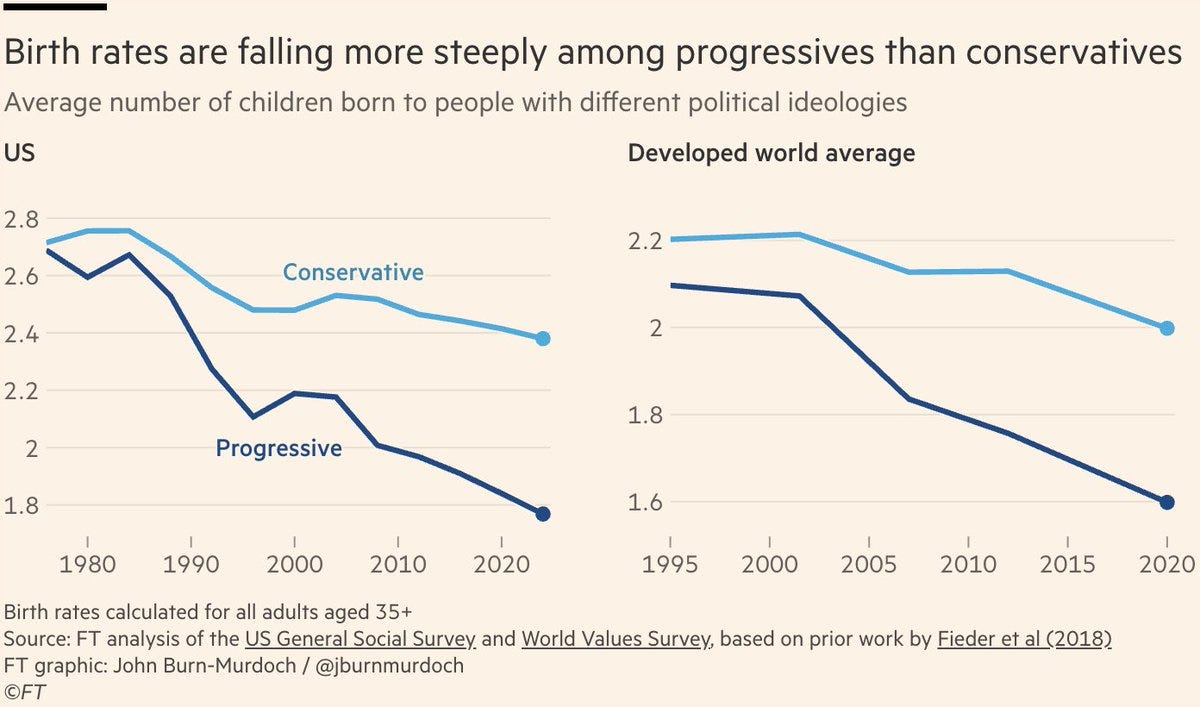
At the same time, a majority of young women in every developed country are left-of-center politically. It is hard to imagine solving the birthrate crisis without progressives playing a major role.
Winning the argument that the world needs more people
As obvious as the fertility crisis is to most people reading this, young people and especially young women haven’t been convinced, and they are the ones whose choices matter.
We are better off with more people
Much of antinatalism comes from our intuitive sense that more people means fewer resources for everyone. That is exactly how things worked in the hunter-gatherer era. If the clan grew too big, some people starved. Paul Ehrlich, author of the fearmongering book The Population Bomb, wrote that as population grew every resource would become scarce and global famine would follow.
But the great economist Julian Simon showed this isn’t how advanced societies work. In 1980, Simon made a wager with Ehrlich, arguing that with more smart people working together, the prices of resources would come down.
And that is exactly what happened. From 1980 to 2025 the world’s population went from 4.4 billion to 8.2 billion while most resources have increased in abundance. How? Very smart people working together found new and better ways to get resources. More people meant abundance, not scarcity.

Economists Marian Tupy and Gale Pooley expanded on Simon’s work in their 2022 book Superabundance, showing that prosperity depends on population growth.
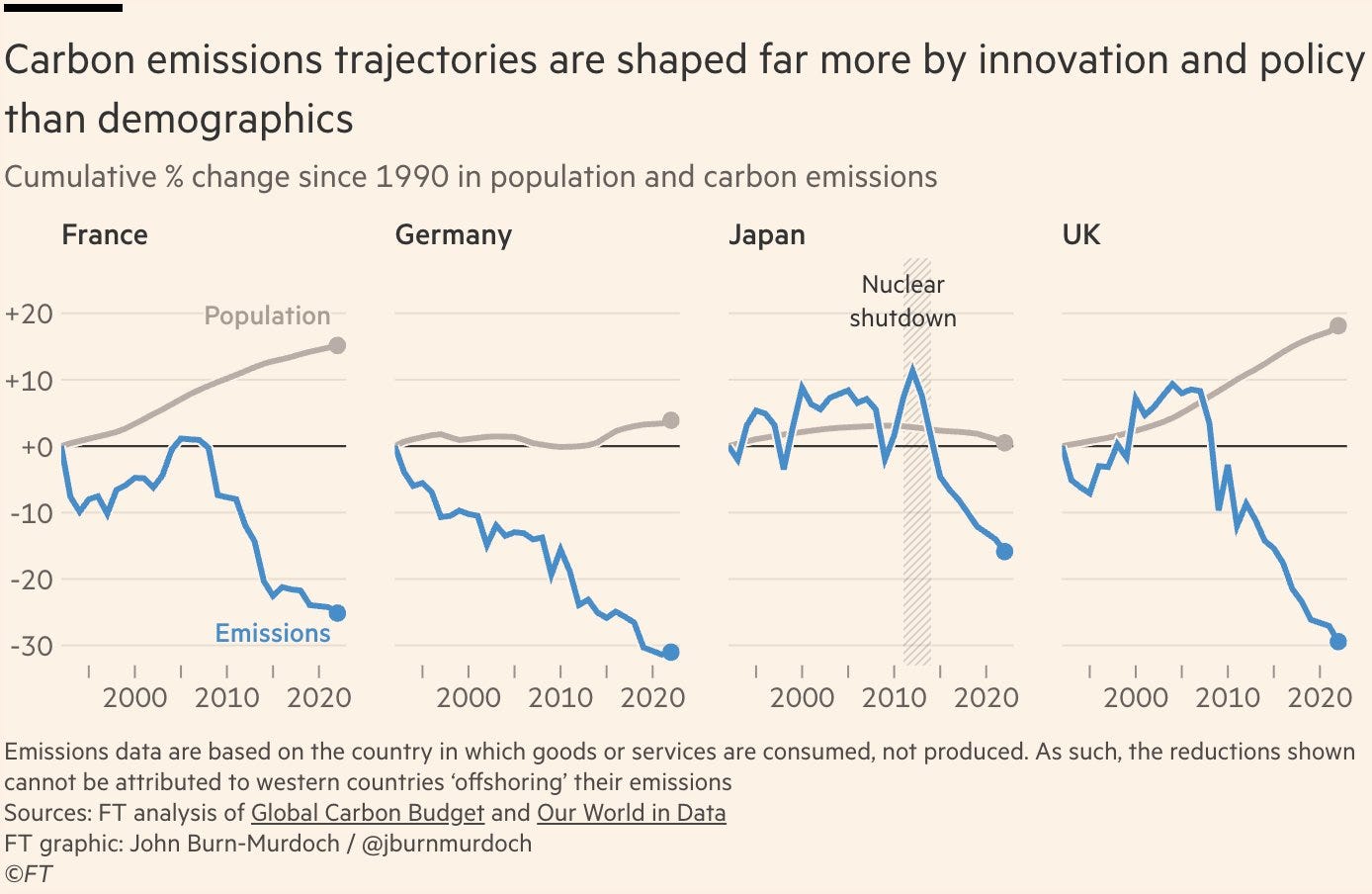
What about environmental degradation? Just last month, data analyst John Burn-Murdoch showed that environmental metrics are getting better, not worse, because of innovation (which comes from of large, educated populations).
The Role of Policy
This is a policy essay, but isn’t the winning argument about having children a private affair? Partly yes, and private organizations will have to rise up to answer the many population control nonprofits that litter the landscape.
But consider what has happened with climate change. Whatever your opinion may be, it is the case that governments all over the world got involved in a big way, in education, in research, in funding solutions and in messaging. Political leaders everywhere made the case for fighting climate change and the trajectory of emissions changed dramatically.
Can the same happen with the birthrates? Yes. When problems arise that threaten nations, governments have to get involved, including by convincing the public. Can governments help build a pronatal culture in a way that is compatible with freedom and democracy? Yes. Look at what was achieved in Israel. And Mongolia. And France.
Something that I think is being missed in these discussions is the true economic leap that a young couple faces when deciding to have a child. Reproductive age people are in the lowest earning years of their working life. In general, having a child implies signing up for one of two economic futures.
A) One parent works and one parent stays home. Very few reproductive-age people earn enough to support a family with a single income. The non-working parent is forfeiting career progression and likely sacrificing future earning potential by stepping back from the workforce.
B) Both parents work. Now you must pay for daycare. Despite the ever rising cost of purchasing a home, daycare is frequently even more than mortgage payments.
Of course, there's grandparents. But grandparent willingness is not a given for many if not most. And even if grandparents are willing, many cannot find both suitable jobs and suitable homes near their parents.
The fact of the matter is that for many people in the developed world, these scenarios are unfeasible. Wages have not risen at the same astronomical rate as housing, not even close. Add daycare on top of that, and it simply just doesn't pencil out.
If it ever becomes the case again that 20-30 year olds with 30th percentile incomes can feasibly afford to provide a modest quality of life for a spouse and 2+ children, then I suspect we will see the fertility rate rise again.
Great article - thank you. Even if women do decide to have children (lifestyle choice change) as we found out with our www.spermegggeddon.com project it is biologically very difficult with dramatic declines in sperm quality and quality - and egg viability caused by the toxic soup we have allowed ourselves to live in. Can we get you to do a podcast on The Truth Contract with a focus on the UK? David